

Buenos Aires hosted the first Ethereum World's Fair from November 17-22, 2025, bringing over 15,000 attendees to La Rural. Borislav and I joined Ambire - project buddies we've been building with for years - for a week of account abstraction talks, networking with crypto frens, and navigating side events that ranged from peak conversations to questionable venue choices.
Devconnect Argentina centered around privacy, zero-knowledge proofs, and interoperability - themes that felt like Ethereum returning to its roots. The crowd mixed crypto OGs with students hunting merch and locals completely new to the space. Here's the unfiltered truth about whether you should bother with the next one.
TL;DR: Should you attend next Devconnect?
Quick takeaways for future attendees:
Do it for: Small side events (KohakuWonders-style), expanding your EF/protocol network, real builder conversations.
Prepare for: Terrible WiFi (bring hotspots), fragmented stages, loud venues, talks competing with 30 other things.
Best approach: Pick specific hubs and camp there. Come for networking, not polished conference sessions.
Pro tips:
- Have offline work setups for demos
- Target intentional gatherings over big parties
- Don't expect traditional conference structure
- Manage expectations on production value
Bottom line: Devconnect is worth attending, but set your expectations right. While some keynotes and sessions are definitely worth catching, the real value is in the side events, builder conversations, and expanding your network in the Ethereum ecosystem.
Note: These impressions are based on the 2025 Buenos Aires event. The experience may vary at future Devconnect locations.
EIP-7702 in the wild: hardware wallet integration reality
I gave a talk at the Account Abstraction Community Hub on EIP-7702 and hardware wallets - stories from the browser-extension frontlines.
I had a slot at the Account Abstraction Community Hub by @erc4337 at the @EFDevcon's World Fair, where I shared my experience from the @ambire browser-extension frontlines.
— superKalo.eth (@0xSuperKalo) November 18, 2025
An honest, slightly chaotic lightning talk and open discussion about bringing EIP-7702 to life inside a… pic.twitter.com/VvkR0uzxdK
An honest lightning talk about bringing EIP-7702 to life inside a browser extension. The reality nobody talks about: Ambire supports Trezor, Ledger, and GridPlus long before EIP-7702. With goodmorning's help, Ambire delivered 7702 support when Pectra launched. Hardware wallets didn't.
We put a "coming soon" label on hardware wallet support, and those users have been stuck in limbo ever since. Confused signers, integration challenges, and hard lessons learned from trying to make cutting-edge protocol features work with hardware that wasn't ready.
What happens when EIP-7702 meets hardware wallets? This is the real story of shipping new protocol features when the ecosystem moves at different speeds. Spoiler: it's messy.
Privacy, quantum threats, and the future
I attended an interesting, almost private talk by Renaud Dubois (Co-founder, CTO at ZKNOX) on post-quantum smart accounts on Ethereum. Renaud and his team are working on a quantum-safe approach for Kohaku, discussing possibilities of the quantum apocalypse. Turned out to be a fascinating topic.
Nadia Ivanova, a colleague buddie from Ambire, spoke at at the Women in Web3 hub, where her session sparked a follow-up discussion about hardware wallet security that debunked one of crypto's favorite myths.
My take on this: "A cable can absolutely compromise your laptop. But breaking a Trezor or Ledger directly through the cable? Extremely far-fetched bordering on fantasy."
Follow up from @winprivacy and @nadia_iv’s session at the Women in Web3 hub during @EFDevcon ARG. We talked about one of the wildest attack vectors people love to imagine: “What if someone hacks your hardware wallet through a malicious cable?”
— superKalo.eth (@0xSuperKalo) November 21, 2025
It sounds scary, but here’s the… https://t.co/ivD2wyoPJs
Hosting wallet security talks at DeFi Security Summit
I got invited to MC the wallet-focused series at the DeFi Security Summit during Devconnect. Four talks, four different angles on wallet security - here's what stood out.
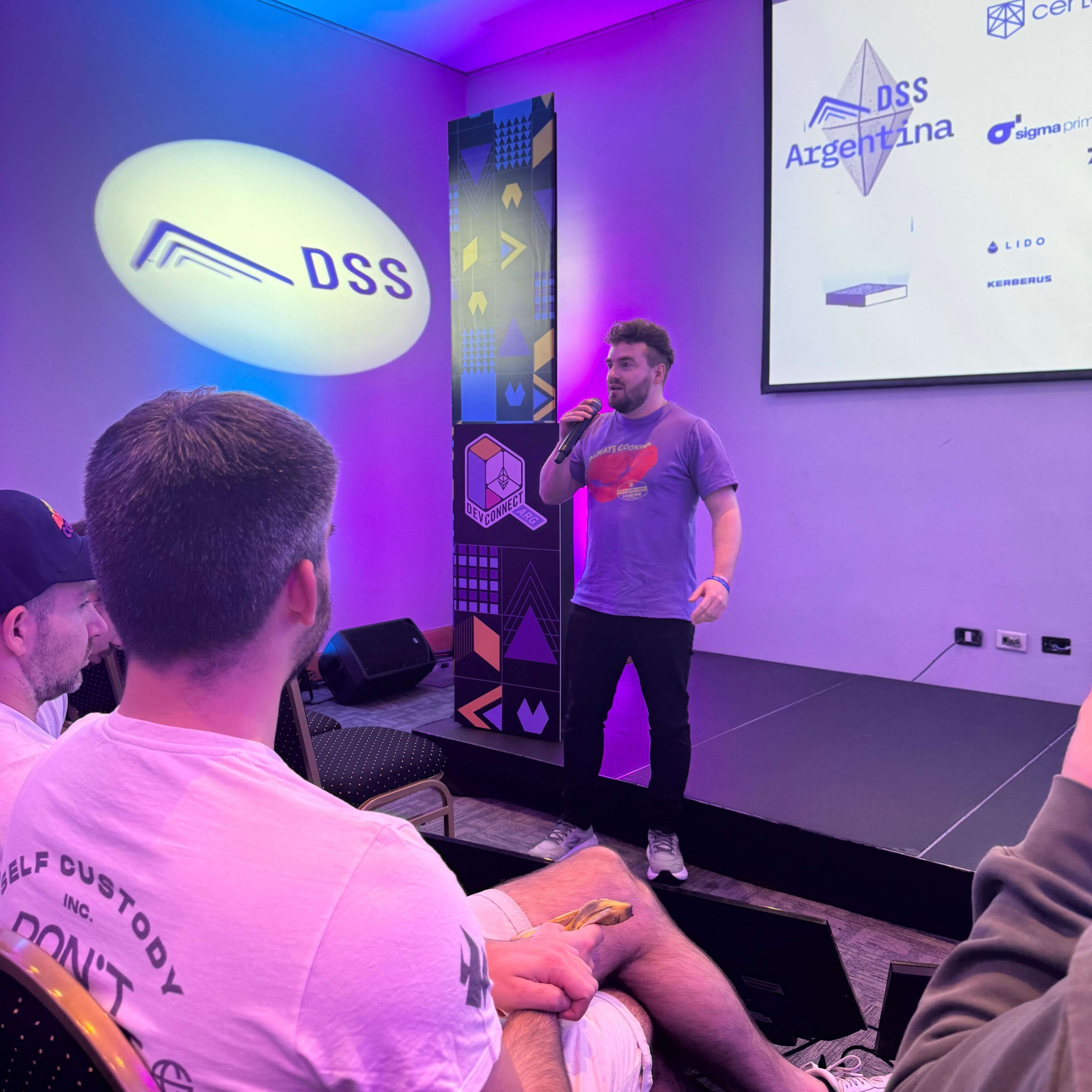
Sessions worth your attention
1. Common security issues in crypto wallets - Hexens broke down recurring weaknesses across browser, mobile, and web wallets. Real audit findings, clear patterns, actionable fixes. If you build wallets, this one hits close.
2. Securing Ethereum's trillion-dollar economy - Agus from Safe delivered a deep dive into modern self-custody: on-chain coordination, programmable guards, mobile-native approvals. Multisig is still key, but it's no longer the whole story.
3. Proving security with TEE attestations - Jack Jones from Turnkey argued for moving beyond "just trust your provider." He explained how TEEs, attestations, and reproducible builds create verifiable trust.
4. The new security paradigm after EIP-7702 - Ofir from Kerberus explored how EIP-7702 lets EOAs behave like smart accounts. New attack surfaces, new defensive patterns, and a clear call for wallet providers to rethink assumptions. Let’s just say the Ambire crew (myself included) and Ofir ended up agreeing to disagree - most of his takes didn’t land with us.
Side events: from builder nights to peak networking
Builder Nights by MetaMask & Frens
Borislav and I couldn’t help but miss the cool laid-back MetaMask gathering. The conference panels ran, but the real value was in the conversations outside.
Ended up talking about payments, staking while spending, and how to avoid bleeding on FX while traveling. Met a bunch of friends from previous conferences.
Day 1 of @EFDevcon’s World Fair ends at Builder Nights BA 🇦🇷 by @MetaMask & Frens.
— superKalo.eth (@0xSuperKalo) November 18, 2025
The setup with the domes looked cool enough, and the crowd was solid, but the night felt pretty laid back overall.
Panels weren’t doing much for me, so most of the useful conversations happened… pic.twitter.com/lpKd2BG64J
KohakuWonders - the peak side event
This was it. Quiet space, small group, real conversations. They presented Kohaku privacy features. Met core folks from Kohaku, Wonderland, and others.
Bobby said this event alone justified coming to Buenos Aires. Fully agreed.
There are two kinds of networking events. The loud ones with music, food, and a crowd. And the quiet ones with a small, intentional group where real conversations happen. The second type fits us best. Managed to expand the network significantly, especially around EF, Kohaku, and Wonderland. This was the most valuable part of the trip.
The not-so-great: what Devconnect needs to fix
“Had a blast at DevConnect, as always. The community delivers every time, but not everything was rainbows and butterflies.”
1. Connectivity crisis Bad WiFi crossed from annoying to blocking actual work. Demos stalled, builders couldn't sync repos, basic coordination was painful. Tech conferences need at least one stable network.
2. AA hub setup fail Fantastic speakers, zero environment for talks. No separation from noise, no proper stage. These talks deserved better. The AA hub at Devcon Bangkok was way better - this one didn't come close. The speakers put in real work preparing technical content, and the organizers gave them a setup that guaranteed nobody could focus.
3. Too much fragmentation 30+ parallel agendas meant great talks had tiny audiences. Speakers competed with everything happening simultaneously. More consolidation needed.
Real-world win: stablecoins done right in Argentina
As a foreigner in Argentina, I was honestly confused by how payments worked - and how much I was actually paying every time I used a card. The inflation is brutal, and the way fees and conversions stack up isn’t obvious until you do the math.
That’s when I met Hugo Montenegro, co-founder of Peanut, and finally understood something many people get wrong: a "stablecoin card" behaves nothing like using stablecoins themselves.
With a stablecoin card you're doing this: USDC → USD (via card processor) → ARS (via standard FX). With Peanut you go USDC → ARS directly, capturing the cripto-dólar rate (the real peer-to-peer/CEX rate) rather than the typical FX route.
When I tested it, I got ~7% better ARS rate compared to Revolut. Revolut is considered the gold standard in FX in Europe. That 7% difference isn't just impressive - it matters. In a country that saw 117.8% inflation last year, getting a better rate protects people's money and lets you pay like a local.
Peanut is still in beta phase. If you need an invite, DM me on X @0xSuperKalo.
Final thoughts
Still loved the week and the friends we met. The community delivers every time. But the organizational issues need fixing so the next Devconnect hits harder.
Curious what the next edition will bring? Devcon 8 is heading to Mumbai, India in Q4 2026. If you’re thinking about attending, keep an eye out - because if there’s one thing Devconnect guarantees, it’s that no two events are ever the same.

Written by Kaloyan Kosev
JavaScript engineer specializing in React, React Native, Node.js, and Web3. I started coding in high school, teaching myself programming while classmates focused on literature and arts. By graduation I was building award-winning websites, led AIESEC teams (at university), won awards, and lectured. Today, I’m a partner at goodmorning and helping Ambire craft a next-generation Web3 wallet for Ethereum and beyond. I work hands-on with progressive web apps, hybrid mobile apps, and browser extensions, while also shaping processes and supporting teammates.
Ready to take the next step in your Web3 journey?
Drop us a message and let's see what Web3 development services we can do for you.
You may also like...
Check out our recent blog posts

How to build a passwordless Web3 login system
Passwordless Web3 login replaces passwords with wallet-based message signing. Learn how SIWE, nonce validation, backend sessions, and UX design work together to secure authentication.

EthCC Cannes 2026 recap: valuable insights
EthCC[9] in Cannes from a builder’s perspective - Aave V4’s new architecture, the real challenges of shipping EIP-7702 in wallets, practical ZK use cases, and the side events where the best conversations actually happened.

How to verify wallet ownership in a Web3 app
Verifying wallet ownership in a Web3 app requires more than connecting a wallet. This guide explains message signing, backend signature validation, nonce handling, and secure session creation so you can implement authentication correctly and prevent replay attacks.