
Home > Blog > Industry playbook > How non-technical founders build Web3 startups (guide)
How non-technical founders build Web3 startups (guide)
By Goran Stoyanov
Nov 04, 2025 • 11 min read

While technical founders disappear into rabbit holes debating gas optimization and smart contract architecture, non-technical Web3 founders are out there solving real problems, closing funding rounds, and building the products that actually get people to give a damn about Web3.
Spoiler alert: business strategy beats technical complexity every single time. Here's why non-technical founders are eating everyone's lunch - and how the right technical co-founder partnership can turn your Web3 vision into reality without you touching a single line of code.
Why the "coding required" myth is killing Web3 innovation
The gatekeeping narrative that Web3 belongs exclusively to developers? Complete nonsense. This toxic myth suggests that unless you can write Solidity smart contracts or debug blockchain protocols in your sleep, you have no business building in the decentralized future.
It's holding back the entire industry and frankly, it's getting old.
Here's the brutal truth the developer echo chamber doesn't want to admit: The most successful Web3 companies aren't winning because they built the most elegant smart contracts - they're crushing it because they understand what users actually want and build experiences that don't make people want to throw their laptops out the window. According to the Ethereum Foundation, drastically lowering barriers to entry is essential for mass adoption - and that requires founders who understand users, not just code.
While developers argue about consensus mechanisms, successful non-technical founders are asking: "What problem are we solving that people will actually pay for?" Guess which approach builds billion-dollar companies?
Why non-technical Web3 founders have unique competitive advantages
They obsess over users, not code architecture
While developers get excited about zero-knowledge proofs and threshold signatures, non-technical founders ask the questions that actually matter:
- "Why would someone choose this nightmare UX over their current solution?"
- "How do we hide all this blockchain complexity so users can just... use the product?"
- "What problem are we solving that people will actually pay for?" In a space infamous for terrible user experiences and products that only crypto nerds understand, this approach is pure gold for Web3 startup success.
They pivot fast, not after rewriting the entire codebase
Non-technical founders think in market opportunities, not technical limitations. They're the ones who:
- Pivot fast when the market tells them they're wrong (instead of doubling down on "elegant code")
- Spot underserved user segments that developers completely ignore
- Build partnerships that actually matter (not just echo chamber back-patting)
- Focus on business models that make money, not just "cool tech" that impresses other developers
They're natural translators in a jargon-obsessed industry
Web3 desperately needs people who can explain blockchain without making everyone's eyes glaze over. Non-technical founders excel at this because they learned the space from a business perspective first - they're natural translators who can bridge the gap between "revolutionary technology" and "stuff people actually want to use."
Spoiler: mainstream adoption doesn't happen because your smart contract is elegant. It happens because your product solves real problems without requiring a computer science degree to understand.
Web3 success stories that prove the point
Think you need to be a developer to build a billion-dollar Web3 company? These founders would like a word:
Jean-Marie Mognetti - CoinShares
Background: Finance and investment management expertise, not computer science Impact: Co-founded Europe's largest digital asset investment firm by understanding institutional investor needs and regulatory frameworks, proving that traditional finance expertise translates powerfully to Web3.
Chris Larsen - Ripple
Background: Serial entrepreneur with business and finance background, not development Impact: Co-founded Ripple and revolutionized cross-border payments by understanding banking systems and enterprise needs, not by writing blockchain code.
Kathleen Breitman - Tezos
Background: Philosophy and economics education Impact: Co-founded Tezos - a billion-dollar blockchain project by focusing on governance and community, not just clever code.
Cameron and Tyler Winklevoss - Gemini
Background: Economics degrees from Harvard, Olympic athletes, early Bitcoin investors Success: Built a regulated cryptocurrency exchange and custodian by focusing on compliance, institutional trust, and user protection rather than technical complexity.
Notice a pattern? Economics degrees, finance backgrounds, business strategy. Not a single "I learned Solidity in my basement" origin story. These successful Web3 founders built billion-dollar companies on business fundamentals and market understanding - not clever code.
How technical co-founders accelerate Web3 startup success
Here's the thing: being non-technical is an advantage, but trying to become technical while building a startup? That's a recipe for disaster.
The winning move? Partner with someone who's already a technical expert while you focus on what you do best.
Speed to market (while your competitors are still learning)
Learning blockchain development takes years. By the time you can write a secure smart contract, your market opportunity is gone and three competitors have shipped. A Web3 technical co-founder gets you from idea to MVP in months, not years. You focus on validating the market; they focus on building the product.
Security expertise (because one vulnerability can kill you) Web3 is brutally unforgiving. Smart contract bugs cost billions according to Chainalysis. Security vulnerabilities destroy projects overnight. There's no "oops, we'll patch it later" in blockchain - once it's deployed, it's permanent.
Technical co-founders bring the Web3 security expertise to avoid these landmines. They know where projects fail, what vulnerabilities to watch for, and how to build security-first from day one.
Strategic technology decisions that matter
Choosing between Layer 1 and Layer 2, picking the right development stack, deciding on cross-chain compatibility - these aren't just technical decisions, they're business strategy decisions that determine whether you scale or die. The wrong choice here can kill your startup before it even launches.
Investor credibility that opens doors
VCs want to see technical credibility in your founding team. A strong technical co-founder partnership signals you can actually execute, not just talk a good game at networking events. It's the difference between getting meetings and getting checks.
The no-code trap: Why AI tools get you started but can't get you there
Here's the trend everyone's obsessing over but refuses to tell you the brutal truth: non-technical founders using no-code tools and AI coding assistants to build Web3 products.
Tools like OpenAI Codex, Claude Code, Replit., Lovable, Github Copilot, v0, and no-code blockchain platforms promise you can build anything without touching code. And yes, they'll get you to a rough MVP that might even work for basic validation.
But here's where the fairy tale ends.
The reality check nobody talks about
AI-generated code hits a wall fast. Here's what actually happens when the honeymoon phase ends:
- Technical debt accumulates like compound interest - AI writes code that works today, not code that survives tomorrow
- Security vulnerabilities multiply faster than rabbits - AI doesn't understand Web3-specific attack vectors or the creative ways hackers exploit smart contracts
- Integration nightmares that make you question your life choices - connecting different AI-generated components becomes an impossible puzzle
- Performance degrades until your users hate you - gas optimization and efficiency aren't exactly AI's strong suit
- Maintenance becomes a black hole - nobody understands the codebase, and debugging becomes archaeological work
When no-code makes sense (and when it doesn't)
Use AI/no-code for:
- Initial concept validation
- Quick prototypes for investor demos
- Testing market demand
- Building landing pages and marketing sites
Don't use AI/no-code for:
- Production smart contracts (security nightmare waiting to happen)
- Complex DeFi protocols
- Anything handling real money
- Products you plan to scale beyond MVP
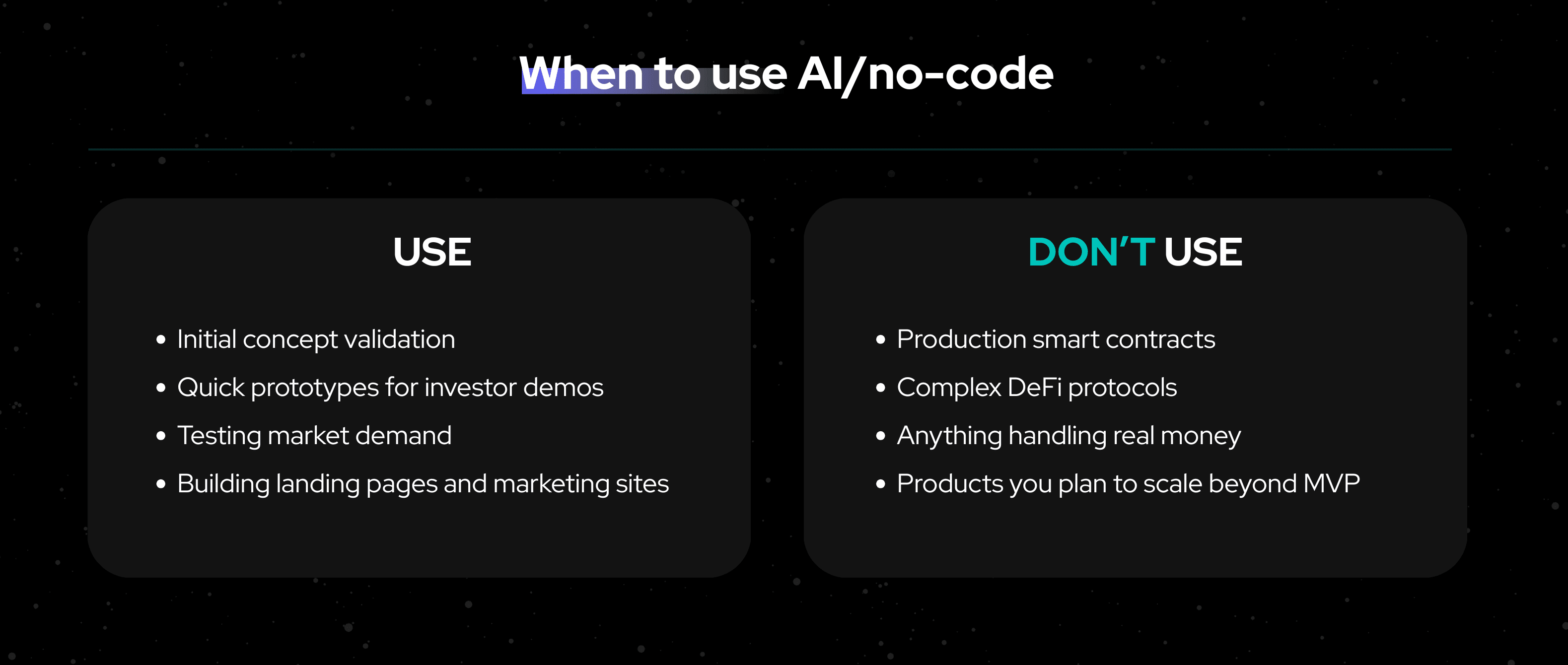 The smart approach: Use no-code tools to validate your Web3 idea and prove market demand, then partner with experienced Web3 developers to build the real product properly. Think of AI as your sketching tool, not your construction crew.
The winning formula: Business vision + technical execution
The most successful Web3 startups combine the best of both worlds:
Non-technical founder superpowers:
- Market understanding and user empathy (while developers build for other developers)
- Business development and fundraising (the stuff that actually pays the bills)
- Partnership development and community building (beyond the crypto echo chamber)
- Regulatory navigation and compliance planning (boring but essential for survival)
Technical co-founder contributions:
- Secure smart contract development (without the security holes that kill projects)
- Blockchain architecture and scalability planning (building for success, not just demos)
- Security auditing and risk mitigation (keeping you out of the crypto graveyard)
- Integration with DeFi protocols and Web3 infrastructure (making everything actually work together)
Together? Unstoppable. You handle the business strategy and market understanding while they handle the technical execution. It's like having a business brain and a technical brain working in perfect harmony.
Your roadmap to Web3 startup success as a non-technical founder
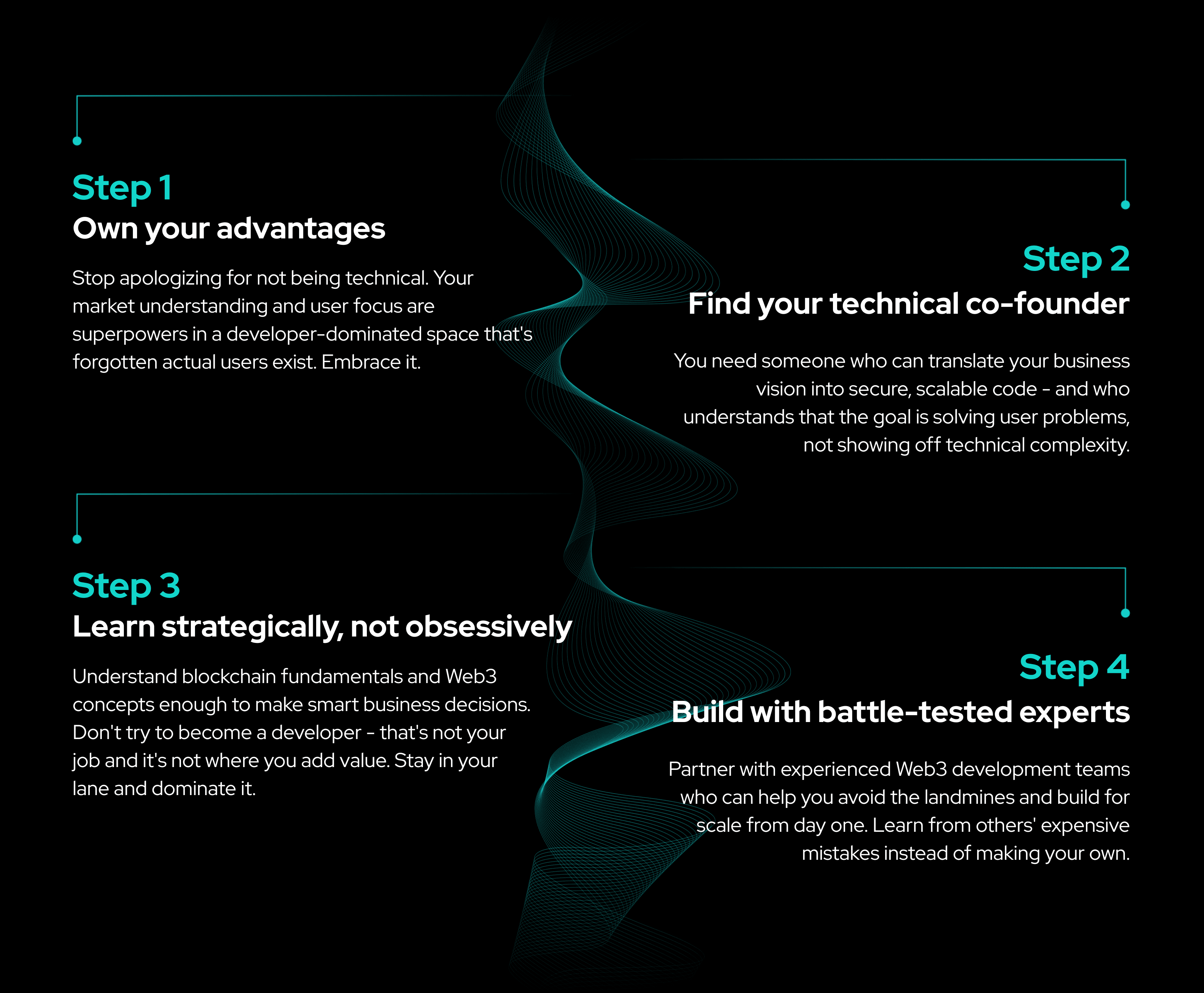
Step 1: Own your advantages
Stop apologizing for not being technical. Your market understanding and user focus are superpowers in a developer-dominated space that's forgotten actual users exist. Embrace it.
Step 2: Find your technical co-founder (not just any developer)
You need someone who can translate your business vision into secure, scalable code - and who understands that the goal is solving user problems, not showing off technical complexity. Learn more about how technical co-founder partnerships work.
Step 3: Learn strategically, not obsessively
Understand blockchain fundamentals and Web3 concepts enough to make smart business decisions. Don't try to become a developer - that's not your job and it's not where you add value. Stay in your lane and dominate it.
Step 4: Build with battle-tested experts
Partner with experienced Web3 development teams who can help you avoid the landmines and build for scale from day one. Learn from others' expensive mistakes instead of making your own.
Mistakes that'll kill your Web3 startup
- Trying to learn everything: Focus on your strengths, partner for technical expertise. Jack of all trades, master of none doesn't work in Web3.
- Falling in love with technology: Start with user problems, then pick the right tech solutions. Cool tech that nobody wants is just expensive art.
- Relying too heavily on AI-generated code: Great for prototypes, terrible for production. Don't let AI write your smart contracts unless you enjoy getting hacked.
- Underestimating security: In Web3, security isn't optional - it's survival. One vulnerability and you're done.
- Ignoring compliance: Regulatory planning should start on day one, not when lawyers come knocking. Ask Terra Luna how ignoring compliance worked out.
- Building in an echo chamber: If only crypto nerds understand your product, you don't have a business - you have an expensive hobby.
FAQ: The real talk version
Q: Can I actually build a successful Web3 company without coding? A: Hell yes. Most of the biggest Web3 successes were built by non-technical founders who found the right technical partners. Your job is strategy and market understanding, not writing Solidity contracts.
Q: Should I use AI tools to build my Web3 product? A: For validation and prototypes? Absolutely. For production code handling real money? Absolutely not. Use AI to prove your concept, then build it properly with experienced developers who won't get you hacked.
Q: How do I find a technical co-founder who won't just build cool tech nobody wants? A: Look for developers with proven Web3 experience AND the ability to translate business requirements into technical solutions. Bonus points if they've shipped products people actually use, not just impressive demos.
Q: What should I actually learn about blockchain? A: Focus on business applications, user experience implications, and strategic technology decisions. Understand enough to make smart choices, but leave the implementation to experts. You don't need to know how to build a car to know which one to buy.
Q: How do I know if my technical partner is actually good? A: Look for real-world experience, not just certifications. Have they built products that handle real money? Do they obsess over security? Can they explain complex concepts in simple terms? If they can't explain it simply, they probably don't understand it well enough.
Ready to stop making excuses and start building?
Your non-technical background isn't a limitation - it's your secret weapon in a space drowning in technical complexity and forgetting about users.
The magic happens when you find the right technical co-founder partnership to turn your vision into reality while you focus on what you do best: understanding markets, building relationships, and creating products people actually want to use.
Stop waiting for permission. Stop thinking you need to learn Solidity. Start building. Download our "Non-technical founder's Web3 roadmap" - a comprehensive guide with templates, checklists, and strategies for launching your Web3 startup without writing a single line of code.

Written by Goran Stoyanov
Goran Stoyanov is a developer-turned–managing partner at goodmorning.dev, combining a decade of hands-on engineering with responsibility for vision, client strategy, and execution in Web3.
Ready to take the next step in your Web3 journey?
Drop us a message and let's see what Web3 development services we can do for you.
You may also like...
Check out our recent blog posts

How to build a passwordless Web3 login system
Passwordless Web3 login replaces passwords with wallet-based message signing. Learn how SIWE, nonce validation, backend sessions, and UX design work together to secure authentication.

EthCC Cannes 2026 recap: valuable insights
EthCC[9] in Cannes from a builder’s perspective - Aave V4’s new architecture, the real challenges of shipping EIP-7702 in wallets, practical ZK use cases, and the side events where the best conversations actually happened.

How to verify wallet ownership in a Web3 app
Verifying wallet ownership in a Web3 app requires more than connecting a wallet. This guide explains message signing, backend signature validation, nonce handling, and secure session creation so you can implement authentication correctly and prevent replay attacks.