
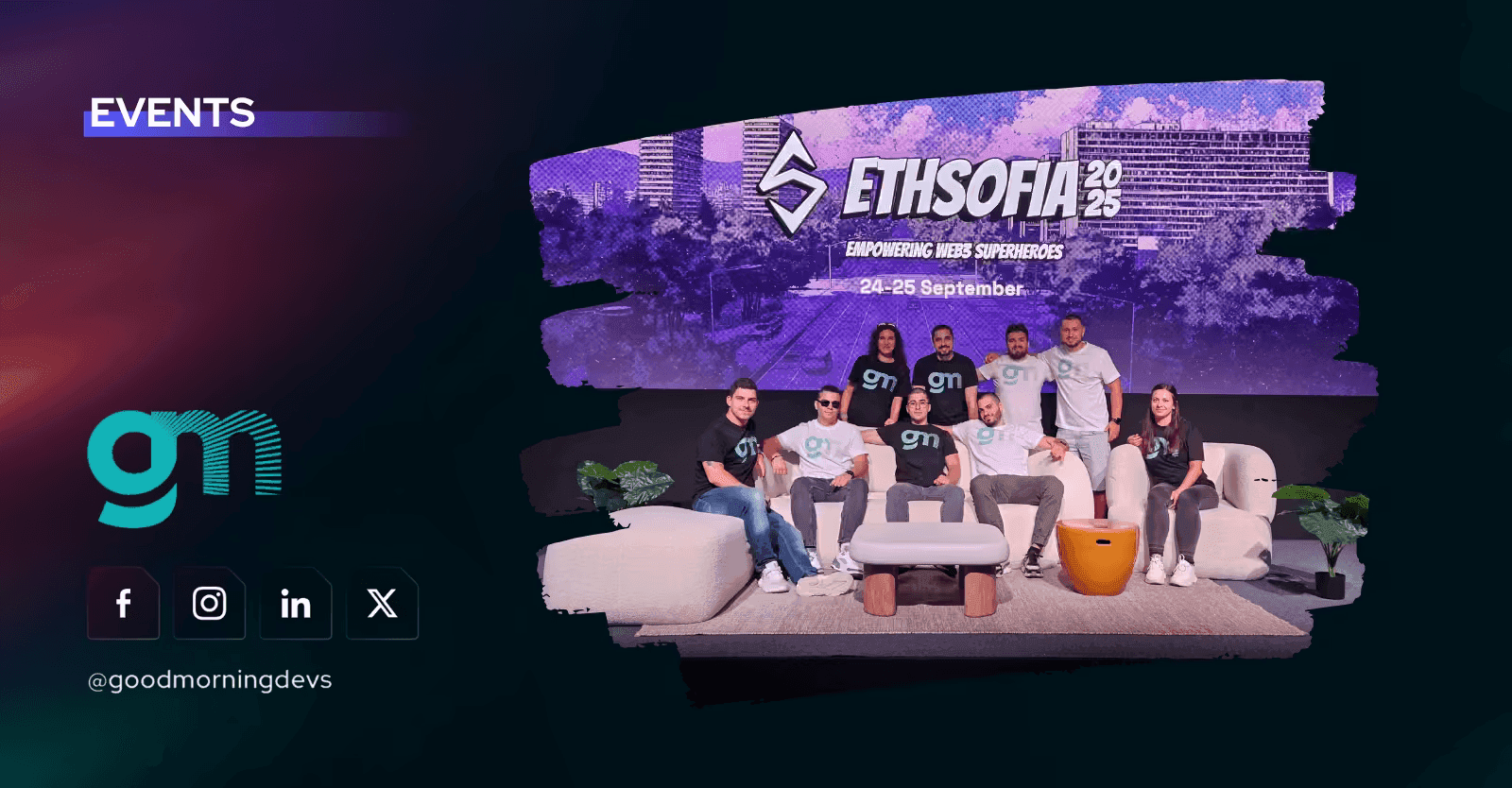
We just wrapped ETH Sofia 2025, and it was a solid regional Ethereum gathering with its own unique flavor. Different from the size and energy of international Ethereum events, but smaller-scale conferences bring their own advantages - easier access to speakers, more focused networking, and room for creative moments.
The highlights: lyutenitsa, crypto grannies, and fancy cars
Sometimes the best networking tools aren't pitch decks - they're homemade Bulgarian relish. Our lyutenitsa stunt grabbed more attention than we expected:
Rumors are we really cooked something during the weekend before @ETHSofiaBG
— goodmorning (@goodmorningdevs) September 24, 2025
Come find our homemade lyutenitsa near the @ambire booth ✌️ Post a pic on X, tag us and get one for yourself. #ethsofia2025 pic.twitter.com/z1I6BMQt1u
People loved it. We personally gifted jars to Miroslav Zaporozhanov (now leading CryptoPro), Vladislav Dramaliev (Founder of ETHSofia), Blagovest Belev (Founder at BlockChain.bg), and Krum Pashov (Founder at Pashov Audit Group). Nothing says "let's build together" quite like sharing food you actually made yourself.
But the real standout moment? Our project buddies from Ambire brought a traditional Bulgarian granny choir to perform a crypto song. Yes, you read that right:
Unexpected? Yes
— ambire.eth (@ambire) September 25, 2025
Iconic? Absolutely
We were honored to invite a traditional granny choir to perform a crypto song at @ETHSofiaBG 💜🎶 💜🎶 pic.twitter.com/9vNGI0R0gf
Peak Web3 culture meets Bulgarian tradition. The Ambire crew absolutely nailed the vibe - creative, memorable, and completely on-brand for what makes local Ethereum events special. They also brought a Renault Twizy as an interactive installation - attendees could cover it with stickers, turning it into a collaborative, evolving artwork throughout the conference.
 There was also a Tesla Cybertruck courtesy of Bitomat, plus Lamborghini performances that had everyone talking. Spectacle has its place at conferences - it gets people engaged and creates memorable moments.
The vibe: smaller scale this year
ETH Sofia 2025 had a noticeably calmer vibe compared to last year’s edition. The crowd was smaller than anticipated, which meant less hustle and easier access to speakers, but also fewer networking opportunities than we'd hoped for.
No hackathon this time around either. In 2024, it brought 58 participants who submitted 20 projects according to Dora Hacks - a solid showing of hands-on technical engagement that was missing this time around.
Regional conferences generally offer their own perks: more focused conversations, and less fighting through crowds. But this year's turnout was lower than expected. If there's another edition, we're hoping for a bigger crowd and more opportunities to meet builders from the local ecosystem.
Sessions worth your time: UX, security, and North Korean hackers
ETH Sofia 2025 brought 44 talks and panels with 80 speakers total. Plenty of topics got covered - here's what actually stood out.
Web3 UX still sucks (but it's getting better)
Ivo Georgiev from our project partners at Ambire took the main stage to break down what's changed after the Pectra upgrade:
Web3 UX sucks. Yep, it does. @Ivshti from @ambire takes the Main stage at @ETHSofiaBG to explain what's changed after the Pectra upgrade. pic.twitter.com/nJ4np87ek6
— goodmorning (@goodmorningdevs) September 24, 2025
The core message: Ethereum's UX is improving, but we're not at mass adoption levels yet. EIP-7702 and account abstraction are steps in the right direction, but the ecosystem needs broader wallet and dApp support before we see CEX-level simplicity.
Bridging TradFi and DeFi
A topic that comes up often among our crew members is the integration of financial services and tools into DeFi. Luckily, there was exactly such a panel at ETH Sofia 2025, led by Ivan Petrov (SVP of Consumer Technology and General Manager, Paysafe Bulgaria), Petko Karamotchev (CEO and Co-Founder, INDUSTRIA), Vugar Usi Zade (COO, Bitget), and moderated by Robert Hristov (Journalist, Capital). We were definitely interested.
After the session, our own Kalo shared his thoughts on the matter.
What’s the biggest challenge when trying to integrate traditional finance tools with DeFi protocols?
— goodmorning (@goodmorningdevs) September 24, 2025
Here's what @0xSuperKalo from our team has to say. Let's see the
Bridging TradFi and DeFi panel now at @ETHSofiaBG @Paysafe @industria_tech @usithetalk @bitgetglobal pic.twitter.com/89XCrTr7qT
His main point: the hardest part isn't writing the bridge or integration itself - it's combining the best of both worlds. Traditional finance brings regulation, trust, and user protections. DeFi brings math-based security, 24/7 operations, and full freedom with self-custody.
The three major differences? Different rules (regulation vs. code), different speeds (banks close at 5 PM vs. 24/7 operations), and different user expectations (easy onboarding vs. full responsibility).
Kalo's example of a product that nails this balance: Gnosis Pay. It combines self-custody and DeFi (holding assets in a smart contract) with traditional payment rails (paying with crypto at regular stores via Visa). Integrations like this could be the next big leap forward.
The Hermit Kingdom Hacks: billion-dollar crypto heists
This session was the standout. Simeon Nguen (Security Architect - Crypto Custody, Commerzbank) broke down how North Korea's government has spent years encouraging hackers to target Western financial systems - first banks, then crypto. Instead of attacking protocols directly, they've shifted to social engineering and compromising key people with access to sensitive systems.
Case in point: the Bybit hack, the largest in history. A huge chunk of the stolen funds reportedly goes toward North Korea's nuclear weapons and intercontinental ballistic missile programs. This isn't opportunistic crime - it's state-sponsored policy spanning decades.
The talk also covered a recently popular scam, a sophisticated attack targeting Web3 developers, agencies, and even HR/BD teams. Here's how it works:
- Scammers pose as prospective clients and send coding challenges via Bitbucket or GitHub repositories
- The repository includes hidden malicious code
- As soon as the project runs, the script quietly runs the malicious code
- The payload executes in-memory (bypassing antivirus), extracting browser cookies, system password manager entries, and crypto wallet credentials
- Stolen data is first exfiltrated to a remote server, after which a second-stage payload is downloaded from the same server to implant a persistent backdoor, ensuring the attacker retains long-term access
Our own Goran Stoyanov flagged a similar attempt targeting our BD team. We caught it before any damage was done, but it's a stark reminder: always verify urgent client requests, audit repositories before execution, and use sandbox environments for unknown code.
At goodmorning, we're proactive about this stuff - regular cybersecurity workshops, internal documentation of real-world attack scenarios, and pairing devs with security specialists for new code evaluations. If you're building in Web3, you need to be just as paranoid.
Other notable sessions
- Nicolas Bacca (Co-Founder of Ledger and ZKNox) - "Can Hardware Wallets Keep Up with the Future of Crypto Security?" - A solid, practical lecture on hardware wallet security, covering different architectures, trade-offs, challenges these devices will face in the future, and potential solutions. Worth attending if you care about keeping your assets safe.
- Viktor Uzunov (CEO and Founder, UEB3) - "Trenches to Boardrooms" - Viktor broke down how a bit of ingenuity and well-timed decisions can help anyone create a token that actually generates interest and value - maybe even something meaningful. The talk covered navigating the chaos of low-cap memecoin trading, spotting real signals in all the noise, and turning those lessons into a trading strategy that lasts.
Panels that caught our attention
The conference had 8 panel discussions tackling everything from securing a trillion dollars onchain to navigating crypto regulation, Web3 UX, and the investment landscape for 2026. One in particular caught our attention.
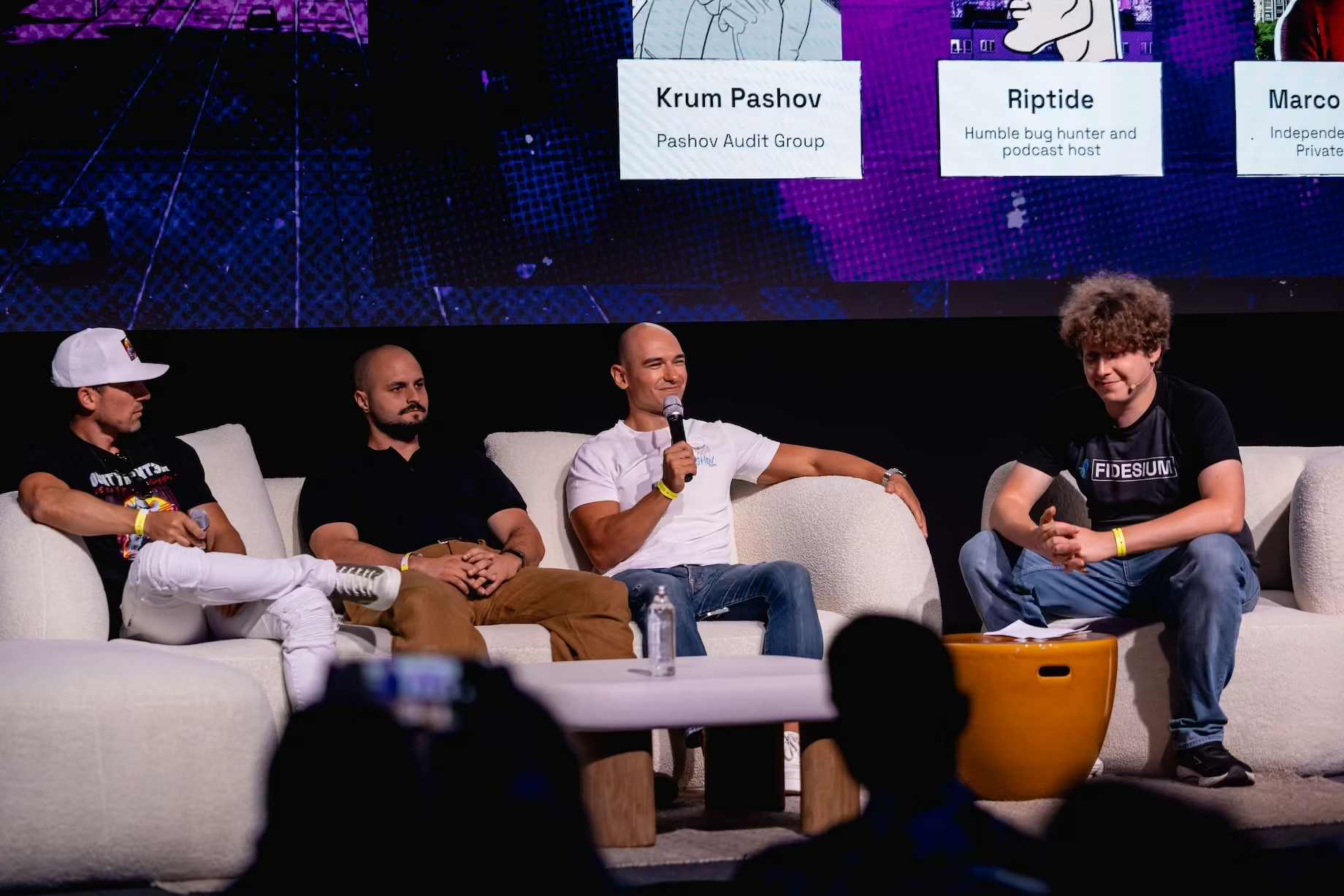
- Beyond the Frontier: The Next Era of Web3 Security (Krum Pashov, Riptide, Marco Hextor, and Abraham Polishchuck) This panel was genuinely interesting. It covered a lot of ground, but the standout topic was AI in Web3 security audits. The consensus? AI can save you time and help spot bugs, but you can't rely on it as an automated solution - it throws too many false positives and will likely waste more time than it saves. Marco Hextor was the most active during the discussion and shared an interesting take: he wouldn't open-source his own AI approach for others to replicate, but he believes companies offering these services should provide some level of transparency. Krum seemed the most skeptical about AI replacing Web3 security professionals anytime soon.
Year two: a different vibe
Based on our experience from last year's edition, ETH Sofia 2025 had a noticeably different vibe. In 2024, there were 58 hackathon participants submitting 20 projects, a fixed agenda, and the energy of a first-time event where nobody knew what to expect. The cypherpunk aesthetic was on point, the speaker lineup was stacked, and the hackathon component gave builders a real reason to show up.
ETH Sofia 2025 took a different approach: calmer atmosphere, no hackathon, fewer attendees, but still focused on regional talent and community building. The production felt more grassroots this time around, with last-minute program changes and speaker swaps. Less polish than major international conferences, but the focus on local ecosystem connections remained.
What stood out at ETH Sofia 2025:
- Local talent spotlight: Bulgarian and Eastern European blockchain builders doing impressive work
- Cultural creativity: Crypto grannies singing at an Ethereum conference? That's the kind of unexpected moment you won't find at every event
- Community connections: Strengthening the local ecosystem with face-to-face interactions
The Bulgarian blockchain community is active, technically skilled, and well-connected. Events like ETH Sofia help amplify that - even if there's room for improvement in execution.
The bottom line: are regional events worth it?
Wondering if local Ethereum conferences are worth your time? It depends on what you're after. If you're expecting the same level of organization, production value, and speaker lineup as major international events - you'll probably be disappointed. Regional conferences operate on different budgets and timelines, and that shows.
But if you want direct access to a regional crypto community, face-to-face conversations with local builders, and a glimpse into what's happening in specific ecosystems - they're absolutely worth attending. You'll learn more about Eastern European Web3 talent in two days at ETH Sofia than you will reading LinkedIn profiles for a month.
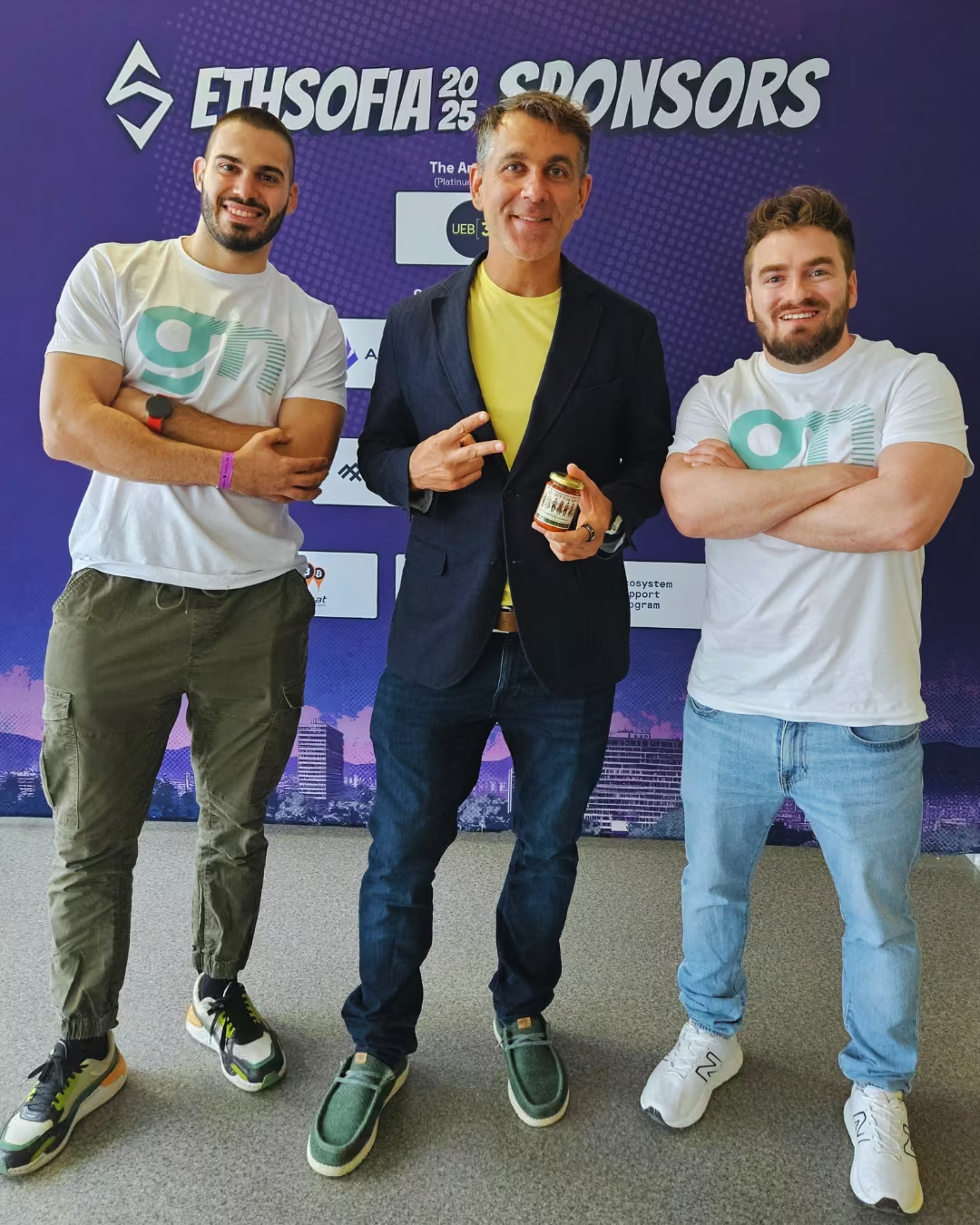
Plus, where else are you going to see crypto grannies performing at a blockchain conference while handing out homemade lyutenitsa?

Written by Goran Stoyanov
Goran Stoyanov is a developer-turned–managing partner at goodmorning.dev, combining a decade of hands-on engineering with responsibility for vision, client strategy, and execution in Web3.
Ready to take the next step in your Web3 journey?
Drop us a message and let's see what Web3 development services we can do for you.
You may also like...
Check out our recent blog posts

How to build a passwordless Web3 login system
Passwordless Web3 login replaces passwords with wallet-based message signing. Learn how SIWE, nonce validation, backend sessions, and UX design work together to secure authentication.

EthCC Cannes 2026 recap: valuable insights
EthCC[9] in Cannes from a builder’s perspective - Aave V4’s new architecture, the real challenges of shipping EIP-7702 in wallets, practical ZK use cases, and the side events where the best conversations actually happened.

How to verify wallet ownership in a Web3 app
Verifying wallet ownership in a Web3 app requires more than connecting a wallet. This guide explains message signing, backend signature validation, nonce handling, and secure session creation so you can implement authentication correctly and prevent replay attacks.